To play this video, you must accept cookies from US providers.
For details, please see Cookie Settings in
our Privacy Policy.
Consent to the setting of cookies from US providers can be given
either here or
under Cookie Settings in our Privacy
Policy The revocation of consent already
given can be done in the same way.
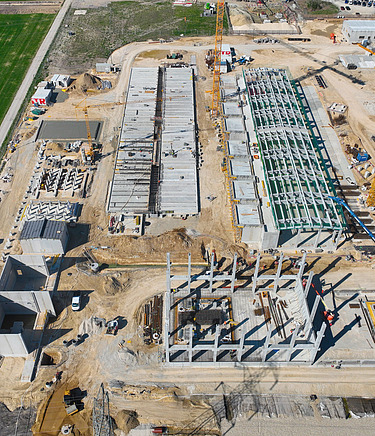
A huge 140-megawatt electrolysis plant is being built in Bruck an der Leitha on behalf of OMV. STRABAG and Siemens Energy are combining their expertise to plan and construct the plant, which will produce up to 23,000 tonnes of green hydrogen for industry each year using wind, solar and hydro power once completed. This will make it the largest plant in Austria and one of the largest in Europe.
Hydrogen is a versatile element and is climate-neutral when renewable energy sources are used in its production. The green hydrogen produced will be used directly at the Schwechat refinery. This will make fuels, chemical products, and production processes more sustainable, while reducing the site’s CO₂ emissions.
What is an electrolysis plant?
An electrolysis plant uses electricity to split water into hydrogen and oxygen. The technology and design of such a plant are highly complex and must be perfectly coordinated for it to function smoothly. A continuous flow of water and electricity must be guaranteed, and the building services must operate without disruption.
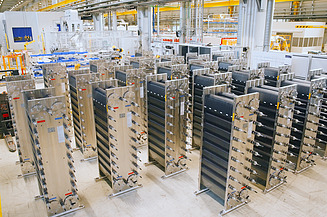
Electrolysers are lined up in the Siemens production facility in Berlin.
The electrolyser is the heart of an electrolysis plant. The two most common technologies used in electrolysis plants are proton exchange membrane (PEM) and alkaline (AEL) electrolysers. In AEL, a chemical lye is needed for hydrogen production. For this project, PEM technology is being used, which does not require any additional chemicals in the creation of hydrogen.
How does an electrolysis system work?
Water molecules (H₂O) are made up of hydrogen (H₂) and oxygen (O₂). Electrolysis is currently the most common method of splitting water into its gaseous components using electricity. The electrolyser itself consists of cell assemblies (anode, membrane and cathode), which are stacked to form stacks. The water used for electrolysis must undergo treatment to filter out impurities and reduce conductivity before use.
What is green hydrogen?
When electricity from renewable energy sources is used to produce hydrogen, we refer to it as green hydrogen. If hydrogen is produced from fossil fuels such as natural gas, releasing CO₂, it is called grey hydrogen. Green hydrogen is produced without emissions; the only by-product is oxygen. It can be used in various ways, such as in the energy supply, industrial processes, or as fuel for heavy goods vehicles. In the future, hydrogen could even power our construction machinery. At our Kanzel quarry in Gratkorn, we have been testing a Liebherr hydrogen-powered wheel loader in practical operation for two years, refuelling it with green hydrogen at our own on-site filling station.
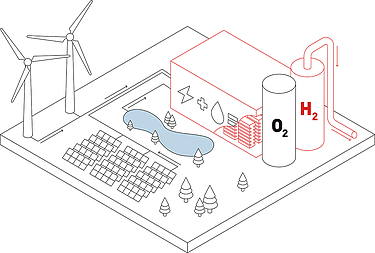
Electrolysis uses electricity to split water into hydrogen and oxygen. If electricity from renewable sources is used for this, it is green hydrogen.
Green hydrogen for the decarbonisation of industry
The OMV electrolysis plant, with a capacity of 140 megawatts, is set to produce up to 23,000 tonnes of green hydrogen annually from wind, solar and hydro power. The green hydrogen produced is intended to replace fossil hydrogen in existing production processes, thereby making a significant contribution to the decarbonisation of industrial operations at the OMV Schwechat refinery. In total, this will save around 150,000 tonnes of CO2 per year – roughly equivalent to the carbon footprint of 20,000 people. The plant is scheduled for completion by the end of 2027.
Green hydrogen is of particular interest to industry and, in our view, represents an important new business area that we aim to help drive forward. The EU Green Deal identifies hydrogen as a key component for sectors that are difficult to electrify. These include, amongst others, the steel and chemical industries, as well as aviation and shipping. In Europe, around eight million tonnes of hydrogen were produced in 2025 – less than one per cent of which was green. The rest of the hydrogen used today continues to come from natural gas. There is therefore currently a lack of key infrastructure to achieve the EU’s target of producing around 10 million tonnes of green hydrogen locally by 2030. STRABAG is ready to expand sustainable energy infrastructure.
Project details
Client:
OMV Downstream GmbH
Partner:
Siemens Energy
Project start:
June 2025
Completion:
End of 2027
Performance:
140 MW and 23,000 tonnes of H2 per year
Savings:
150.000 tonnes of CO2 per year
Major projects are in our DNA
Electrolysers are highly advanced facilities. For their construction and connection, STRABAG combines its construction expertise with Siemens Energy's technical know-how. Ensuring a smooth process in an electrolysis plant is only possible if every single part of the process is perfectly coordinated. The water flow and power supply must be as reliable as the building services system as a whole. This includes, for example, the cooling of the industrial hall in which the electrolyser itself is installed. We are constructing a secure enclosure for Siemens Energy's central components. This guarantees that the industrial plant will run smoothly and at optimal capacity once completed.
High-tech projects such as the electrolysis plant are in our DNA. We bring extensive construction experience to the table here, combining it with the technical expertise of strong partners. Green hydrogen is a key technology for the future. By constructing such industrial plants, we are helping to create a more sustainable energy infrastructure.
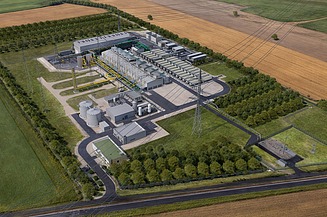
This is what the electrolysis plant will look like once completed.
The project is a pioneering initiative in Austria, not merely because it is the largest plant in the country by far. Currently, far too little green hydrogen is being produced locally. The electrolysis plant will be connected to the Schwechat refinery, making the green hydrogen available for industrial processes.
In the field of renewable energy, STRABAG carries out complex projects such as the construction of power lines in Germany and the global development of wind and solar farms