SuedLink and SuedOstLink: We are building for the German energy transition
New power lines in Germany for a climate-friendly energy supply
Wind and sun instead of coal and nuclear power: Germany is making the switch. A broad transition to renewable energy sources is intended to enable the entire country to become climate neutral by 2045. That is the goal of the nationwide energy transition. In order for decentralised, climate-friendly electricity to flow reliably to where it is needed in the future, the grid needs to be expanded. Two major infrastructure projects are already in full swing: under the leadership of the three grid operators TenneT Germany, TransnetBW and 50Hertz, the largely underground routes for the SuedLink and SuedOstLink direct current lines are currently being built. The two north-south power lines are the cornerstones of the energy supply of the future – and we at STRABAG are playing a key role in their construction.
Strabag builds 400 kilometers for the north-south power lines
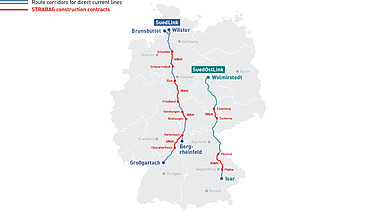
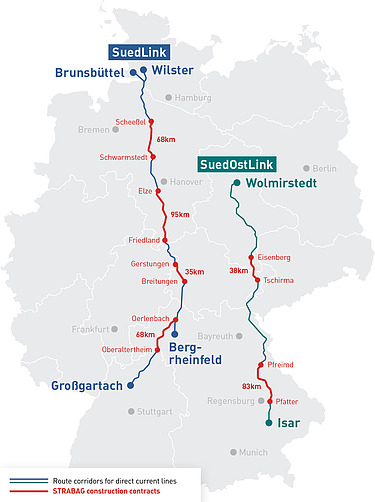
Teams from STRABAG AG are constructing six large construction sections, up to 95 kilometres long, for TransnetBW, TenneT Germany and 50Hertz for the two north-south power lines. In total, we are constructing almost 400 kilometres of lines in Bavaria, Lower Saxony, Thuringia and Saxony – just under 270 kilometres for the SuedLink and around 120 kilometres for the SuedOstLink. This involves civil engineering work on a scale rarely seen before, for which we are pooling our resources: two or more STRABAG units are forming a joint project team to provide the necessary capacity; we are building the SuedLink in southern Lower Saxony in a joint venture with our partner Köster Bau.
Grid expansion in Germany
Route construction combines open and closed methods
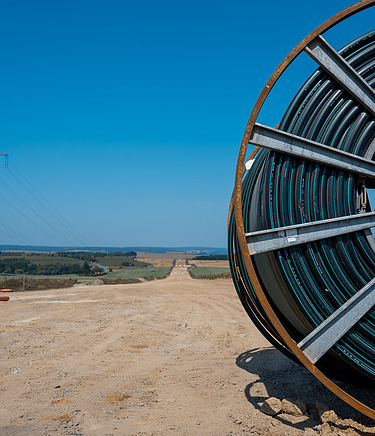
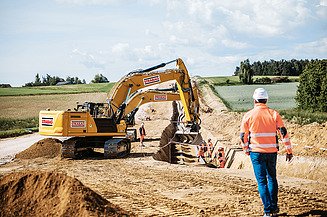
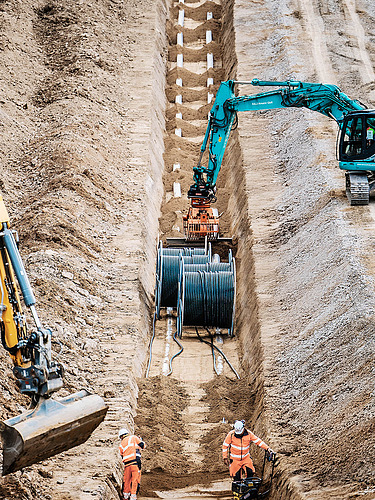
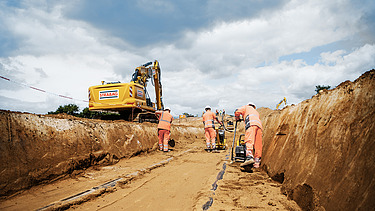
Where possible, our STRABAG teams excavate trenches for the route corridor, lay the protective pipes into which the direct current cables are pulled and backfill the trenches with the excavated soil. However, the open construction method is unsuitable for overcoming obstacles. Where roads or rivers cross the route, horizontal drilling techniques such as HDD flush drilling or microtunnelling are used. This closed construction method with specialised machinery makes it possible to lay the pipes for the underground cables over distances of several hundred metres without digging.
-
Facts and figures about the power lines
- SuedLink and SuedOstLink run largely underground across Germany and will use modern high-voltage direct current (HVDC) transmission technology to transport renewable energy over hundreds of kilometres with minimal losses.
- In future, the approximately 15-centimetre-thick cable strands of the two route corridors will be able to carry up to four gigawatts of electricity from the windy north-east to the south of Germany – and vice versa from south to north.
- To illustrate: one gigawatt (GW) corresponds to the average output of a nuclear power plant unit. The amount of electricity produced with this over the course of a year is sufficient to supply around 2.5 million private households with electrical energy for a year.
Two power line construction sections in detail
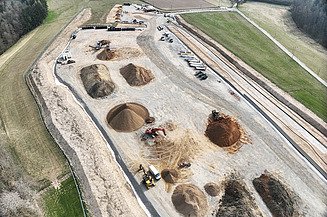
Sustainable soil preparation for the SuedOstLink in the Oberpfalz
Between Pfreimd and Pfatter in the Oberpfalz, STRABAG has been working for TenneT Germany since summer 2024 on sections D1 and D2 of the SuedOstLink – covering a distance of around 83 kilometres. Our work on 100 construction sites with an average length of 650 metres is being carried out flexibly and in sections in order to take archaeological and nature conservation requirements into account. In open route construction, the STRABAG team from Bavaria is using up to 60 excavators and 36 wheel loaders to dig the two cable trenches, which are around two metres deep and 2.20 metres wide, lay empty conduits and construct joint pits and drum stations for the subsequent cable pulling. We pay particular attention to sustainability in this process: we build reversibly, carefully separate soil layers and specifically improve the thermal conductivity of the layer close to the pipes – so that the area can be used for agricultural purposes again later. The HDD flush drilling is being carried out by a team of experts from STRABAG subsidiary RBS, hich is using eight special drilling rigs.
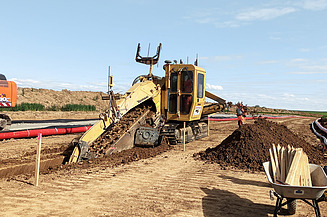
Innovative milling technology for the SuedLink in Unterfranken
In Unterfranken, STRABAG is working with TransnetBW to implement a particularly efficient and environmentally friendly process: for the construction of the power line on the approximately 68-kilometre-long SuedLink section between Oerlenbach and Oberaltertheim, we are combining milling technology and liquid soil technology. Using a special trench cutter, we are not only creating two cable trenches just 80 centimetres wide, but also laying the empty conduits at the same time. The excavated soil is processed into volume-stable liquid soil near the construction site and reused directly – without additional compaction. This saves time, reduces transport and conserves resources. Compared to conventional construction methods, the amount of excavated soil is reduced by a quarter. The combination of milling and liquid soil accelerates the work and minimises the impact on nature and soil structure.
Downloads

Factsheet