Moderately warm asphalt for sustainable road building
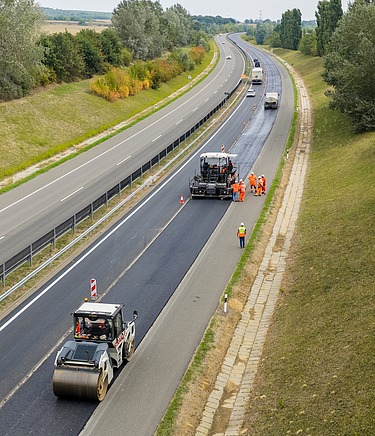
The bitumen foaming process produces as good a quality asphalt mix as conventional mixes, but with 80% less emissions. This so-called WMA asphalt mix was used for maintenance work on the motorway near Pécs.
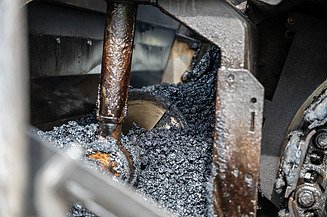
The project is unique in that moderately warm asphalt was used in the construction.
In the spring of 2025, major maintenance works started on the M60 motorway on behalf of the Mecsek Motorway Concession Company (MAK). The works started in April and will continue until October 2025, with continuous traffic flow. The maintenance interventions were limited to sections of 1 to 4 kilometres, where the wearing course and, if necessary, the binder course were replaced in both the passing and the preceding lane. The works included pavement milling and repair, crack repair, barrier raising, pavement markings painting, repair and replacement of mastic asphalt lanes and backfill settlementI
-

The project saved 1026.7 kg CO2e by using moderately warm asphalt instead of conventional asphalt. According to research data from TU Wien, this amount of CO2e could have been offset by planting 48 trees.
Modern solution: moderately warm asphalt
A special feature of the project was that the left lane of the M60 (between sections 9+500-6+700 km, on the section from Pécs to Bóly) was built with moderately warm asphalt (WMA - Warm Mix Asphalt). The asphalt mix was provided by STRABAG's asphalt mixing plant in Pécs, where a new bitumen injection pump and a separate bitumen foaming assembly line were purchased in 2023.
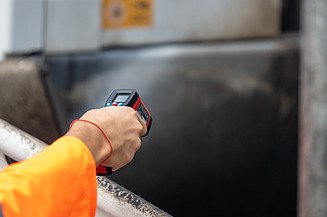
In total, around 2,800 tonnes of asphalt (HMA + WMA) were paved during the project. The two binders were produced at temperatures around 16°C-17°C lower than the conventional process. According to figures presented in a publication by the National Asphalt Pavement Association (NAPA), CO2 emissions were reduced by around 1,026 kilograms.
Advantages compared to traditional asphalt:
- Energy saving: production temperatures are 20-25°C lower, which reduces energy consumption.
- Durability: the lower heat load reduces the ageing of the bitumen, which ensures a longer life.
- Flexibility in design: can be used for longer periods at lower temperatures and transported over longer distances.
- More environmentally friendly working: less harmful fumes are produced, creating better working conditions.
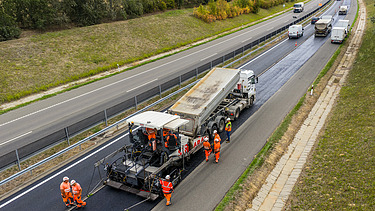
The benefits of the technology are particularly evident in projects with a high proportion of mechanised work and little manual labour - such as motorways, motorways or greenfield projects.
Environmental considerations and recycling
The project also applied the principles of circular economy: with the exception of the SMA wearing course, all the asphalt mixes installed contained 15% recycled content (RC). This resulted in the use of thousands of tonnes of recycled raw materials.
The major maintenance work on the M60 motorway is a good example of how durability and sustainability can be combined in modern road construction. The use of moderately hot asphalt offers a more energy-efficient, environmentally friendly and longer-lasting solution, while recycled materials are incorporated in line with the principles of circular management.
Factsheet:

STRABAG_WMA.pdf